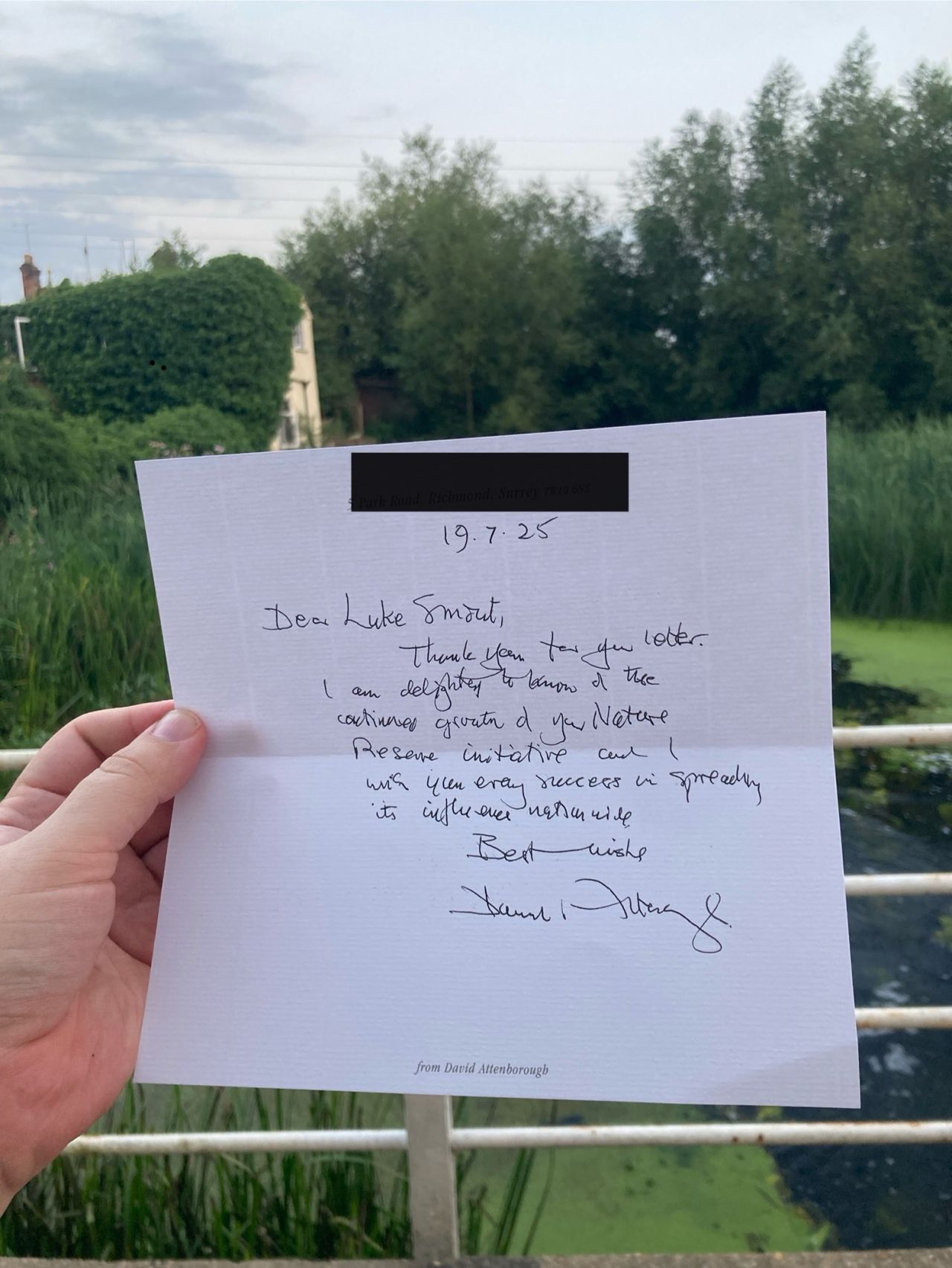
Some moments clearly reaffirm why local conservation work matters. Recently, I received a handwritten letter from Sir David Attenborough in response to the ongoing work of the Community Nature Reserve. In his message, he thanked me for writing and expressed encouragement for the continued growth of the initiative and its wider influence.
For anyone involved in grassroots environmental projects, recognition of this kind is both humbling and motivating. Sir David Attenborough has spent a lifetime championing nature conservation, biodiversity protection and environmental education. To receive personal encouragement from someone so closely associated with these values is a reminder that community-led action has real importance.
The Community Nature Reserve Approach
The Community Nature Reserve was founded on a simple but effective idea. If enough people dedicate a small area of their own land, just three square yards, to wildlife-friendly habitats, those spaces can collectively form a connected reserve that supports local biodiversity.
This approach was successfully demonstrated through the Felixstowe Community Nature Reserve pilot programme, where residents were encouraged to transform gardens, allotments and even window boxes into nature-friendly spaces. The long-term goal of the pilot was to engage 1,666 households, creating a combined wildlife area equivalent to the size of a football pitch.
Participants supported local wildlife by planting nectar-rich flowers, creating ponds, installing bird and bat boxes, and providing safe habitats for insects and hedgehogs. By linking these small spaces together, the project helped improve habitat connectivity across the town and encouraged long-term community engagement with nature.
Why Grassroots Conservation Matters
Community Nature Reserves show that conservation does not need to rely solely on large protected areas. Local action plays a crucial role in biodiversity recovery, particularly in urban and suburban environments. Small-scale projects help people connect with nature, improve ecological resilience, and contribute to wider environmental goals.
Receiving encouragement from Sir David Attenborough reinforces the value of this model. It highlights that local conservation efforts, when combined, can form part of a much larger national and global response to biodiversity loss.
The Community Nature Reserve continues to focus on practical, accessible conservation that empowers individuals to take action where they live. Support and recognition such as this letter strengthen our commitment to protecting and restoring nature at a community level.
About the Author
Luke Smout is a PR and marketing specialist with a strong interest in grassroots conservation and community-led environmental initiatives. He supports local nature projects through strategic communications, public engagement and storytelling, helping communities understand how small, practical actions can deliver meaningful environmental change. Luke believes effective conservation begins locally, driven by people, place and long-term commitment.